
Integration and visibility layer
One line through every job
Quayline connects the systems and people around a port job. Bring us your ideas for implementation and development — we will find the solution and build it. We never replace what you already run.
I run a terminal, warehouse or nautical service
See how Quayline connects your systems without replacing them.
See how it connectsI have an idea or a problem at the quay
Tell us the job that costs you most time, or the idea you have been carrying for a while. We find the implementation solution, prototype in weeks and build only what is used.Tell us the job that costs you most time, or your idea. We find the implementation and build only what is used.
Bring us your idea or problemChapter 1 · At the quay
A berth is where everyone meets, and no one sees the whole job
The ship, the terminal, the warehouse, the boatmen, the agent and customs all meet at the quay. Each has a good system for its own part. None of them sees the job from start to end.
Chapter 2 · Status still travels by phone
The answer exists. Finding it takes a call.
Asking for status
Customers and agents phone or write to ask where a job stands.
Several systems of record
Each system holds one part of the truth, owned by a different team.
Evidence scattered
Photos and confirmations sit in chats until someone needs them.
Chapter 3 · The line
The mooring line, turned into a thread through one job
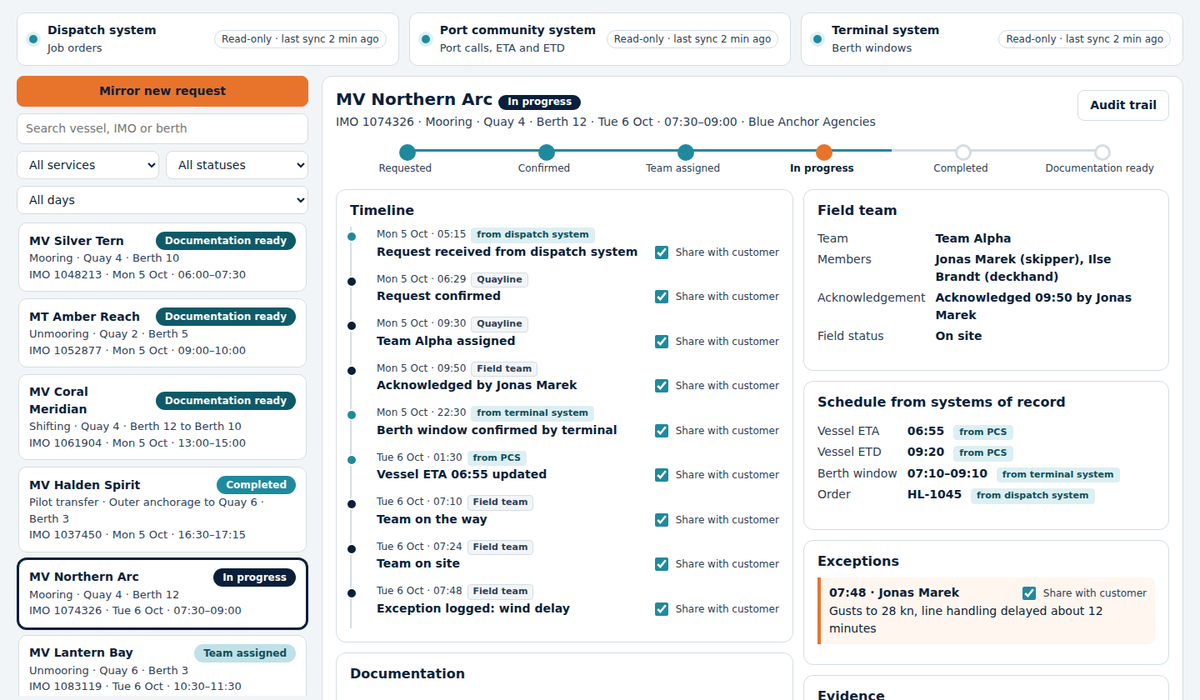
A mooring line ties a ship to the quay. Quayline is the same idea for information: one job record that ties the systems and people around a job. Why the name.
- Request The job is created.
- Field team Confirms on mobile.
- Customer view Sees status live.
- Evidence Notes and photos kept.
- Documentation ready Billing-ready record.
Chapter 4 · Connect, don't replace
Your systems stay the record. We connect them.
Quayline is a thin layer. It starts read-only and shows each person only what you decided to share.
What we never do
- Replace your dispatch, terminal, warehouse or port community system.
- Write into your inventory.
- Show anyone more than you decided.
- Lock your data in.
Neutral by design
No stake in any system we connect to.
Read-only first
With a full audit trail of who saw what.
Permissions per organisation
Each party has its own view.
EU hosting
Your data stays yours and is exportable at any time.
Chapter 5 · Who stands at the quay with us
Each party sees its own part of the job
Terminal operators
Customers see cargo and vessel jobs without calling the desk.
Warehouse operators
A multi-customer view over your warehouse system.
Nautical service providers
Customers follow mooring, towage and similar jobs as they happen.
Shipping agents
The jobs of a port call in one place, not several inboxes.
Chapter 6 · How we start
Small steps. We measure first.
15-minute conversation
How a job runs today, and where status gets lost.
Discovery and workflow mapping
One workflow and the systems around it.
Narrow pilot
KPIs agreed before we start.
Extend on results
More processes or sites only if the pilot shows value.
We promise no numbers. We agree what to measure, then measure it.
Chapter 7 · Bring us the idea or the problem
Software and development that starts from your workflow — you bring the idea, we find how to implement it
Tell us the idea or the job that costs you most time
Describe it in your own words. No technical language needed.
We map it with you and find the implementation that fits your systems
Sometimes the answer is to change nothing.
We prototype in weeks and build only what is used
You see a working version early, then decide.
Chapter 8 · The person behind it
Liviu Stoia
I am a marine service engineer. I have spent time on board and in ports, where a job depends on a phone call, a photo and a signature. I have built field tools from real workflows, so I know how little time a crew has for software.
I am exploring Quayline as an independent venture. It is not a product yet. The first step is to listen to the people who run these jobs.
Let's draw the line through your next job
Have an idea or a problem at the quay? We will find how to implement it — start with the questionnaire.